
Boo! Halloween is nearing so get into the spirit and play any of our over 100 Halloween games on WebPaws Games. Invite your ghouls, friends and family to play along.


 Stumble Upon
 Del.icio.us
 Buzz
Buzz
Comment
Boo! Halloween is nearing so get into the spirit and play any of our over 100 Halloween games on WebPaws Games. Invite your ghouls, friends and family to play along.

Took a while to come up with a way to add or remove dynamic form input fields using jQuery to be able to add specific number of inputs into a database.
See the code in action here:
JSFiddle
$(document).ready(function(){
var nf;
$("#addfeatnow").on('click', SecondFeat);
$("#remfeatnow").on('click', FirstFeat);
var storednf = JSON.parse(localStorage.getItem('nf'));
if((nf == null || !nf) && (!storednf || storednf == null)) {
nf=1;
var storednf = JSON.stringify(nf);
localStorage.setItem('nf', storednf);
$('#feature1').fadeTo('slow', 1 );
$("#feature2").hide();
$("#feature3").hide();
$("#feature4").hide();
document.getElementById("numbfeats").value = 1;
$("#addfeatnow").off('click').on('click', SecondFeat);
$("#remfeatnow").off('click').on('click', NoFeat);
}else if(storednf>=0){
alert(storednf);
switch(storednf) {
case 0:
NoFeat();
break;
case 1:
FirstFeat();
break;
case 2:
SecondFeat();
break;
case 3:
ThirdFeat();
break;
case 4:
FourthFeat();
break;
} //end switch
} //end if statement
function FirstFeat() {
nf=1;
var storednf = JSON.stringify(nf);
localStorage.setItem('nf', storednf);
$('#feature1').fadeTo('slow', 1 );
$("#feature2").hide();
$("#feature3").hide();
$("#feature4").hide();
document.getElementById("numbfeats").value = 2;
$("#addfeatnow").off('click').on('click', SecondFeat);
$("#remfeatnow").off('click').on('click', NoFeat);
$("#remfeatnow").show();
return false;
}
function SecondFeat() {
nf=2;
var storednf = JSON.stringify(nf);
localStorage.setItem('nf', storednf);
$('#feature1').fadeTo('slow', 1 );
$("#feature2").fadeTo('slow', 1 );
$("#feature3").hide();
$("#feature4").hide();
document.getElementById("numbfeats").value = 3;
$("#addfeatnow").off('click').on('click', ThirdFeat);
$("#remfeatnow").off('click').on('click', FirstFeat);
$("#remfeatnow").show();
return false;
}
function ThirdFeat() {
nf=3;
var storednf = JSON.stringify(nf);
localStorage.setItem('nf', storednf);
$('#feature1').fadeTo('slow', 1 );
$("#feature2").fadeTo('slow', 1 );
$("#feature3").fadeTo('slow', 1 );
$("#feature4").hide();
document.getElementById("numbfeats").value = 4;
$("#addfeatnow").off('click').on('click', FourthFeat);
$("#remfeatnow").off('click').on('click', SecondFeat);
$("#remfeatnow").show();
return false;
}
function FourthFeat() {
nf=4;
var storednf = JSON.stringify(nf);
localStorage.setItem('nf', storednf);
$('#feature1').fadeTo('slow', 1 );
$("#feature2").fadeTo('slow', 1 );
$("#feature3").fadeTo('slow', 1 );
$("#feature4").fadeTo('slow', 1 );
document.getElementById("numbfeats").value = nf;
$("#addfeatnow").off('click').on('click', FifthFeat);
$("#remfeatnow").off('click').on('click', ThirdFeat);
$("#remfeatnow").show();
return false;
}
function NoFeat() {
nf=0;
var storednf = JSON.stringify(nf);
localStorage.setItem('nf', storednf);
$('#feature1').hide();
$("#feature2").hide();
$("#feature3").hide();
$("#feature4").hide();
$("#addfeatnow").off('click').on('click', FirstFeat);
$("#remfeatnow").hide();
return false;
}
});
Internet professionals never miss an emerging trend or new technique thanks to Website Magazine’s Design & Development Digest on the Web at wsm.co/desdevdigest
+ Google:
Google’s Cloud Trace, a tool that enables app developers to identify performance issues by displaying the latency distribution for an application, has entered the beta stage: wsm.co/googtrace
+ Netskope:
Cloud security concerns are on the rise, as Netskope reveals that just one in ten cloud apps are secure enough for use within the enterprise: wsm.co/cloudservhack
+ Zend Technologies:
The newest iteration of the PHP application server from Zend Technologies, which provides tools for deploying, monitoring and debugging PHP apps, has released a new version of their application platform for the AWS Marketplace: wsm.co/zendserveraws
+ Apache Spark:
Apache Spark, an open-source cluster computing framework, which is often used as an alternative to Hadoop’s two-stage disk-based MapReduce approach, is gaining adoption among developers looking for faster processing speeds: wsm.co/apachespark
Article reprinted from: http://ezseonews.com/backlinks/best-source-of-backlinks-going-into-2015/
Things have changed a lot in SEO. Long gone are the days when we can post backlinks to your website without having to worry about Google. In fact, if you are relatively new to web site building and have read up on current SEO, you might find it hard to believe that Google used to turn a blind eye to bad, spammy backlinks. Today, this type of link will usually result in a penalty at best, de-indexing being the worse case scenario.
The one thing I get asked more than anything else, is how to get Google-safe backlinks.
My answer is simple.
If you are going out, placing links to your web pages on other website, then they are not safe and you are running the risk of Google penalizing your site.
Google is on the warpath on what it calls “Unnatural links”. That is, any link that is placed, and/or controlled by the webmasters of the site it points to.
Google wants links to be natural.
But what is a natural link? Let me give you an example.
If person A is writing an article for a website, and links to a page written by person B because it contains something relevant to the current discussion, and person A wants his/her readers to look at that page, then the link is natural.
What causes problems is if person A and person B are the same person! Then it becomes a question of is it natural, or is it an attempt to manipulate rankings?
I guess a good definition of a natural link is something like:
A link that is not there simply to influence search engine rankings.
Or,
A link that would be there even if search engines did not exist.
How many links have you built to your own sites that would be classified as “natural” by those definitions?
OK, so Google don’t like link builders. However, we all want our content to rank higher, so while links count towards rankings, webmasters will continue to build links.
If I could only offer you one piece of information about link building, it would be to forget about anchor texts.
That means:
don’t link keyword phrases in an article on SITE A, to a page on your own SITE B.
don’t use keyword phrases when making comments on other webpages. If it asks for your name in the comment form, use yourname.
don’t create resource boxes for articles that link keyword phrases to pages on your own site.
I could give a lot more examples, but the simple rule I now use is:
Don’t create links to your own pages (from other web sites) using keyword rich anchor text. The only exception to this rule is when a page on Site A links to another page on Site A. This type of anchor text link IS natural. You can see this type of linking on Wikipedia, and most good sites as it helps visitors navigate the site. The problem comes when one site links to another using keyword rich anchor text, as that IS NOT natural in most cases.
So what do I use in anchor text?
The Name of the website I am linking to if it is the homepage of the site.
The Name of the article I am linking to.
Occasionally, I’ll use the bare URL, but I prefer option 1 or 2 above.
When I am chatting to people about this, the response I often get goes something like this:
“But I want to rank for best bait for mullet. How can I do that if I don’t use that phrase in anchor text links to the page?”
Most of the time my reply to this question is not well received. My reply is based on what is best for the visitor, and not about the best way to manipulate rankings.
Here it is:
Your page will rank for what Google thinks it should rank for. If your page is a great match for “best bait for mullet”, then it has a good chance of ranking for that term, without having to resort to backlink manipulation techniques. If your page is not such a great match, then:
Make it a great match for that phrase (taking into account the searchers “intent” when typing in that phrase).
Make sure your site has some authority (which requires links, but does not require anchor text rich links).
So what are the best backlinks?
Without question, the very best backlinks possible are those from other sites, created without your involvement, and giving you ZERO input in their creation and maintenance.
So what does that mean?
Well, it goes back to what Google said years ago. Create great content and people will link to it.
The usual response to that statement is “Yeah, right! Like that happens.”
Let me tell you a secret…. It does actually happen if your content is what I call “share-bait”. That is, it is so good that visitors WANT TO SHARE it. If visitors are excited to share something, they will (assuming you give them an easy way to do so, like social sharing buttons).
If a piece of content is really good, it will also naturally attract links because other webmasters will appreciate it enough to know that their own visitors will appreciate THEM for recommending it.
There is just one big problem with all of this. It takes more effort creating the share-bait in the first place, and many webmasters are only after quick results. In addition, the natural acquisition of links is much slower than loading up some automated link building tool and letting it blast links around the web. However, natural link building is safe, and a long-term strategy for those that care about the long-term future and success of their web sites.
Want proof that links can build naturally to a good site?
Here is some.

This is the link data shown in Google Webmaster Tools for one of my affiliate sites. That last column shows the dates that Google found them. Do you know how many of those links I created? ZERO. Not one.
Not all of those links are good ones, but there are quite a few. However, even the really poor links aren’t bad, unless they are on really spammy sites, and then I just disavow those domains. For this site, I haven’t actively looked for links for over a year, yet the site continues to do well,
Here is another affiliate site of mine. This one is less well established:
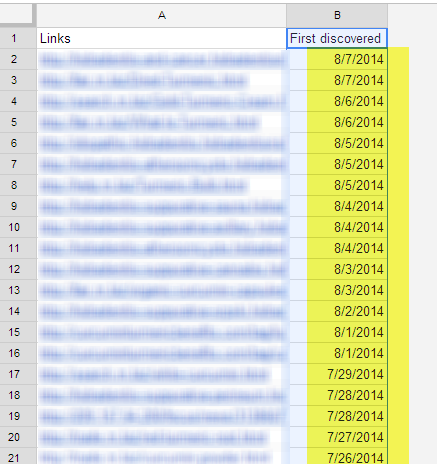
Again, lots of links being found by Google, none of which are anything to do with me. Again, all I do on this site is monitor the inbound links, and if any are coming from spammy domains, I’ll disavow those domains.
For the last 8-10 years, I have always maintained that quality content was the way to go. However, for much of that time, Google allowed spammers to manipulate Google rankings, taking a lot of the power away from really good content. In the last year or two, things have been changing. With Google penalties for link builders, great content is once again starting to show its true value, not only in engaging your website visitors and attracting social shares and links, but in giving Google a reason to rank your site.
Build a website and they will come; or will they? You need to have a website presence to be found, but not every website carries the same weighting when being indexed by a search engine.
Acronyms to remember: SEO (Search Engine Optimization), SE (Search Engine), SMO (Social Media Optimization), HTML (HyperText Markup Language), CSS (Cascading Style Sheet)
Some Key factors for on-site SEO:
=================================
The above are just a few of the more important key factors in providing SEO services to a small or large business. There are many other factors that can affect your PageRank standing with Google and other SEs and should also be incorporated into the SEO plan or marketing strategy.
WebPaws.com looks forward to helping you build a stronger online presence and overall more user friendly website to attract more relevant businesses, users, customers and/or clients.